 Crete Island Guide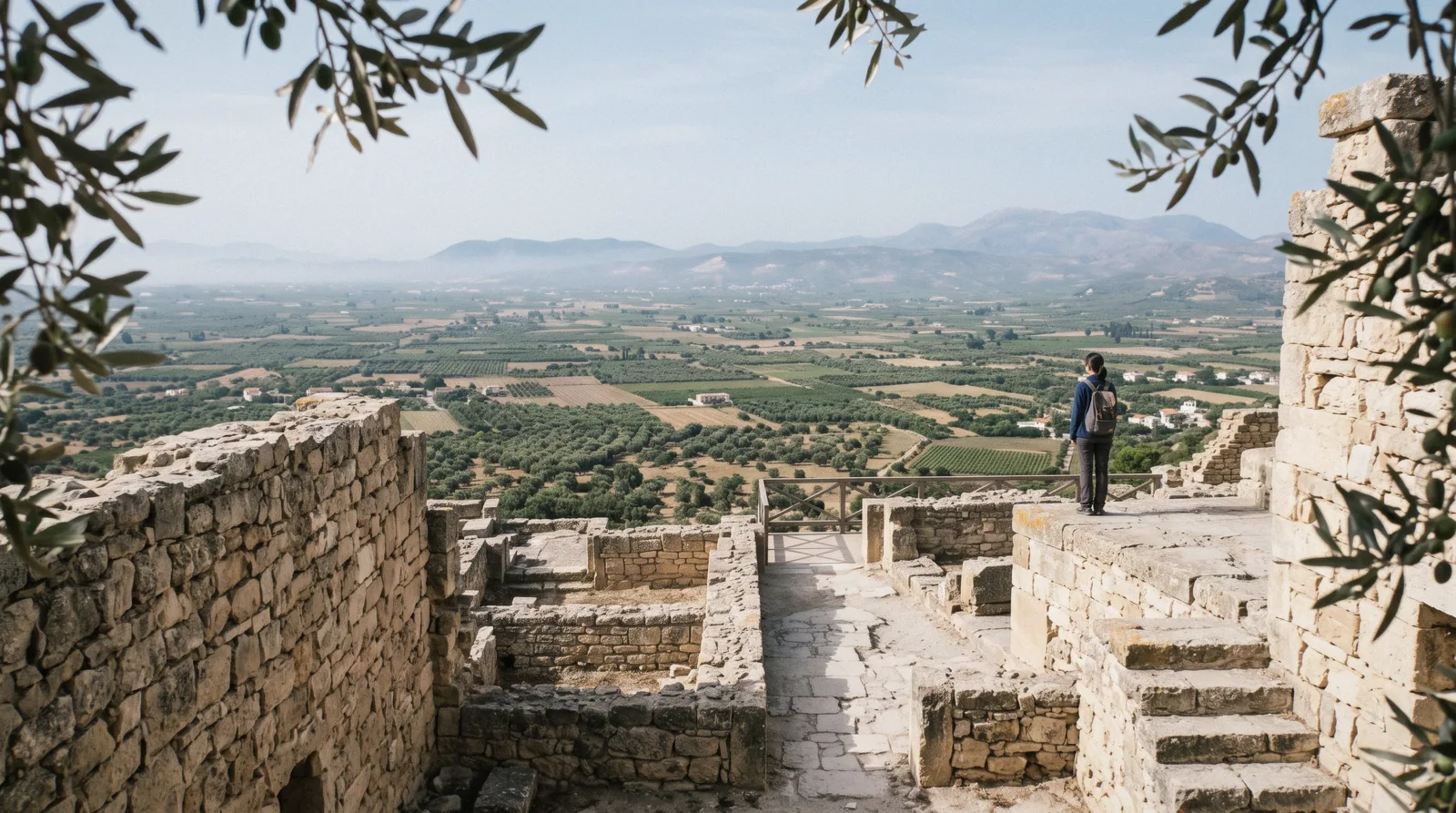
Phaistos was the second-largest Minoan palace on our guide to Crete, Greece, perched above the Messara plain in the south, and the find spot of the still-undeciphered Phaistos Disc. This page covers the honest price and hours, since we sell no ticket here ourselves, what the ruins actually show compared with Knossos, and where the famous disc itself ended up.
Quick answer Phaistos in one minute
Phaistos is the second-largest Minoan palace complex on Crete, on a hilltop above the Messara plain in the south, and the site where the undeciphered Phaistos Disc was found in 1908. Entry costs $16.84 (€15) full price, $8.98 (€8) reduced, paid at the gate since no tour on this page sells the entry itself. Summer hours run 08:00 to a close that steps down from 20:00 to 18:00 across September and October, winter hours are 08:30 to 15:30. Allow 1 to 1.5 hours. The disc itself is not on site. It lives at the Heraklion Archaeological Museum, an hour's drive north.
Key takeaways
- No tour sells entry here. Pay $16.84 (€15) at the gate, or see Phaistos on a private day tour that also visits Matala beach and its caves.
- The Phaistos Disc is not here. See it at the Heraklion Archaeological Museum, where it has been on display since the museum's own renovation.
- Combine it with Gortyn, the Roman-era capital a short drive away on the same south-coast road.
- Fewer crowds than Knossos. Phaistos sees a fraction of the coach traffic, by our observation, even in peak season.
Key facts
Opening hours
| 1 April–31 August | 08:00–20:00 |
|---|---|
| 1–15 September | 08:00–19:30 |
| 16–30 September | 08:00–19:00 |
| 1–15 October | 08:00–18:30 |
| 16–31 October | 08:00–18:00 |
| 1 November–31 March (winter) | 08:30–15:30 |
Closed Closed 1 January, 25 March, Easter Sunday, 1 May, 25-26 December. 6 January, 15 August and 28 October run shortened special hours (08:00-17:00) rather than a closure.
Admission
- Adult
- $16.84 (€15)
- Reduced
- $8.98 (€8), for the categories the Ministry lists
Planning it
- Time needed
- Not stated by the Ministry. Our routing: 1 to 1.5 hours.
- Book ahead
- Optional — walk-up usually fine
- Address
- Phaistos archaeological site, Messara plain, near the village of Agios Ioannis
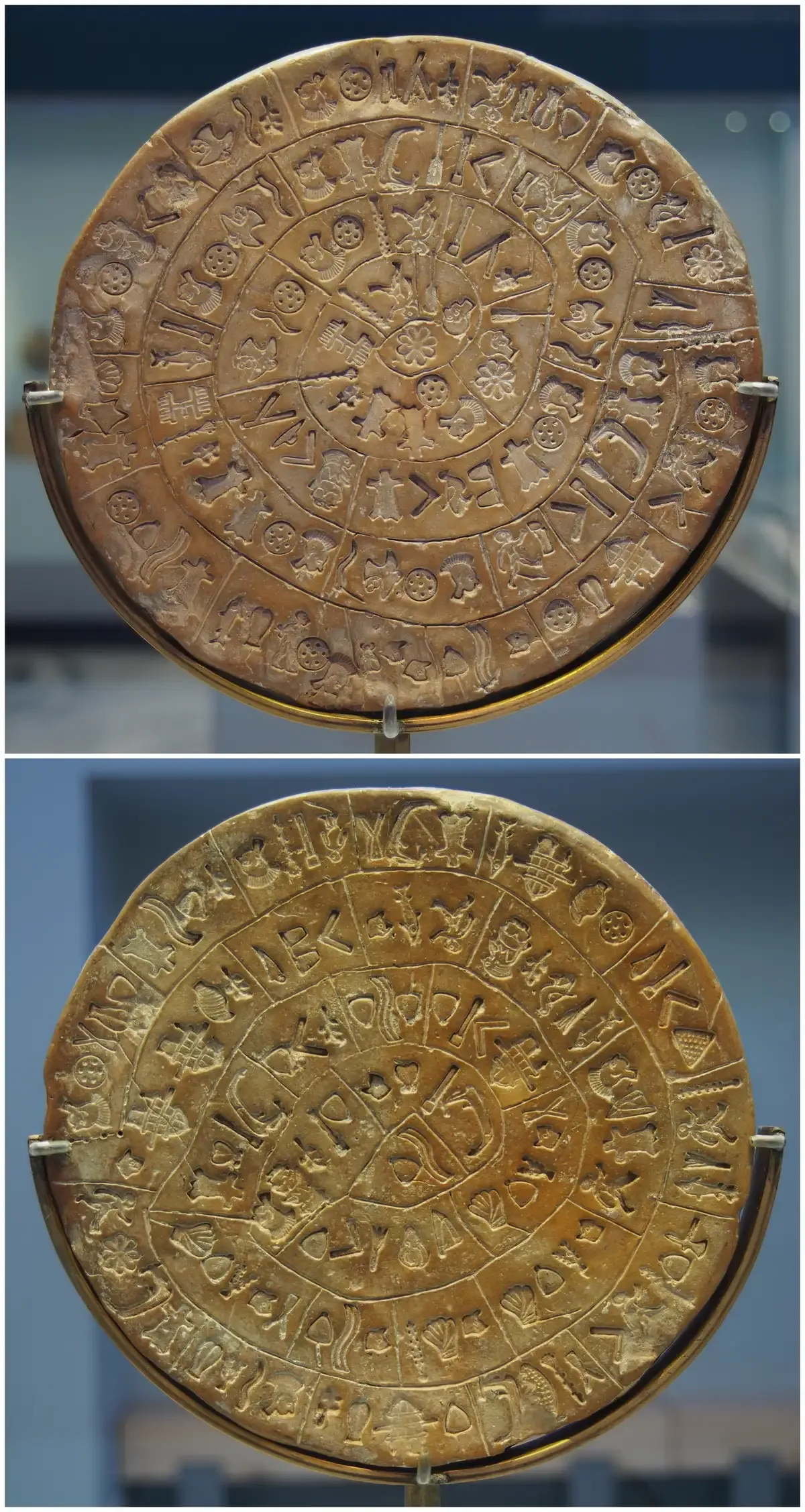
Photo: C messier, crop and composite image by Bammesk, CC BY-SA 4.0, via Wikimedia Commons
Phaistos Price
We sell no ticket for Phaistos ourselves, so the Ministry's own gate price is the price and its own page is the link.
| Where to Buy | Price | Includes | Notes | Book |
|---|---|---|---|---|
| Ministry ticket office, at the gate | $16.84 (€15) full, $8.98 (€8) reduced | Entry to the palace ruins and site paths | No advance booking needed; the site rarely fills | Official site |
Figures are the Ministry of Culture's own published price. Figures current for Q4 2026.
See Phaistos on a Day Tour
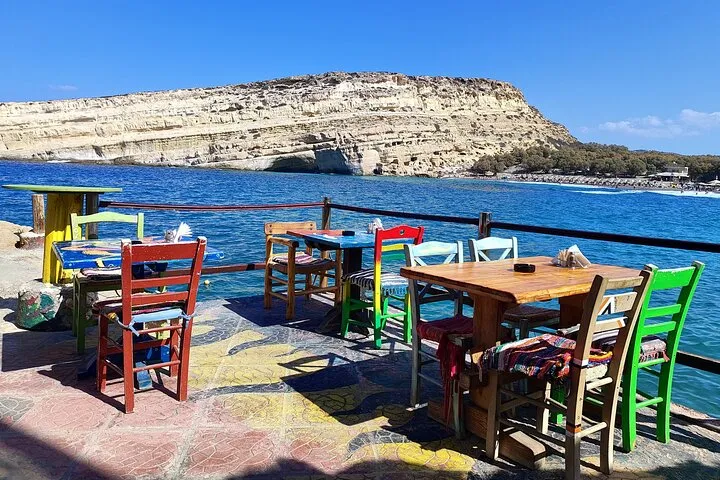
One private day tour on this site visits Phaistos directly, pairing it with Matala beach and its Roman-era caves on the same south-coast loop.
 from $94.03
Matala Beach + Caves, Phaistos Palace & Southern Charm | Private
A private day to the Minoan palace of Phaistos and Matala beach with its caves, on the south side of the Messara plain.
Check AvailabilityPrices, ratings and details are the platform's own. dollar figures are the listed prices — the platform bills in your account's currency.
What Phaistos Is: The Second Minoan Palace
Phaistos ran the southern half of Minoan Crete the way Knossos ran the north, and its ruins are large enough to show that scale even without Knossos's reconstruction.
The Wealthiest City in the South
Phaistos was one of the most important centres of Minoan civilization and the wealthiest, most powerful city in southern Crete, per the Ministry's own history page. It was inhabited from the Neolithic period through the construction and development of the Minoan palaces in the 15th century BC, and the Minoan city covered a considerable area around the palace itself, not just the hilltop ruins visitors walk today.
No Reconstruction, Unlike Knossos
Where Knossos carries Arthur Evans's painted concrete restoration, Phaistos was left largely as excavated, pale stone walls and foundations without repainted frescoes or rebuilt upper floors. The trade-off is a site that asks more imagination of a visitor but shows more of what an actual excavation looks like, and a hilltop setting over the Messara plain that Knossos, inland and enclosed, does not have.
The Scale, By the Numbers
The palace covers a footprint of about 8,400 square metres, roughly two-thirds the size of the palace at Knossos, per Wikipedia's account. Its theatral area, a shallow tiered space used for gatherings, is larger than the equivalent space at Knossos, one of the few points where Phaistos actually outsizes its northern rival. The royal apartments were built from alabaster and positioned to look out toward Mount Ida (Psiloritis), Crete's highest peak, a deliberate siting rather than an accident of terrain.
Site description from the Ministry of Culture's Phaistos description page and Wikipedia.
History: From Minoan Capital to Rival's Conquest
Phaistos outlived its own Minoan palace by more than a thousand years, and its ending came at the hands of a neighbour rather than an earthquake.
Palace, Destruction and Continued Life
After the palace was destroyed in the 15th century BC, the city continued to be inhabited through the Mycenaean and Geometric periods, until the 8th century BC. Later, a temple of Rhea was built south of the old palace, connected according to Wikipedia's account to the ekdysia, a coming-of-age ritual, and the Hellenistic-era city grew extremely prosperous, with houses from that period still visible in the palace's upper west court terrace.
A 2025 UNESCO Listing
Phaistos was inscribed as a UNESCO World Heritage Site in 2025, as part of a joint "Minoan Palatial Centres" listing covering Crete's major Bronze Age palaces, per Wikipedia's account of the 47th session decision. The listing recognises Phaistos alongside Knossos rather than as a standalone site, a formal acknowledgement of the two palaces' shared place in Minoan archaeology.
Destroyed by Gortyn
In the middle of the 2nd century BC, Phaistos was destroyed and absorbed by its neighbouring rival city, Gortyn, a detail the Ministry's own chronology states plainly. Scattered traces of later Venetian-period habitation remain across the site, but Phaistos never recovered its earlier independence.
A Century of Excavation
Archaeological investigation began in 1884 under Italian archaeologist F. Halbherr, continued by the Italian Archaeological School at Athens under Halbherr and L. Pernier from 1900 to 1904, and resumed by Doro Levi from 1950 to 1971. The long excavation history is one reason the site is read today almost entirely through Italian scholarship rather than the British-led work at Knossos.
History from the Ministry of Culture's Phaistos history page.
The Phaistos Disc
The single object most people have heard of from Phaistos is not actually on site.
Discovery and Mystery
The Phaistos Disc, a fired clay disc stamped with 45 distinct symbols occurring 242 times across both sides, was discovered on 3 July 1908 by Italian archaeologist Luigi Pernier during excavation of the palace. It is usually dated to the second millennium BC, with scholarly estimates ranging from around 1850 BC to the early 14th century BC. Despite many attempts, the script remains undeciphered, and no consensus solution exists for what it says or even what kind of writing system it represents.
Where to See It
The disc is on display at the Heraklion Archaeological Museum, not at Phaistos itself. Visitors expecting to see the original artifact on site are often surprised to find only replicas, if any, at the palace, which is one more reason to pair a Phaistos visit with the museum back in Heraklion.
The Disc Was Not the Only Writing Found Here
Phaistos has produced 61 other inscribed Linear A items, Wikipedia's count breaks down as 26 tablets and 35 sealed documents, plus 12 sealed roundels, 9 of them carrying Linear A characters. None of this administrative writing has the disc's fame, but it confirms the palace ran a real bureaucracy, record-keeping that predates the disc's own still-unexplained script.
Discovery and dating details per Wikipedia and the Phaistos site page.
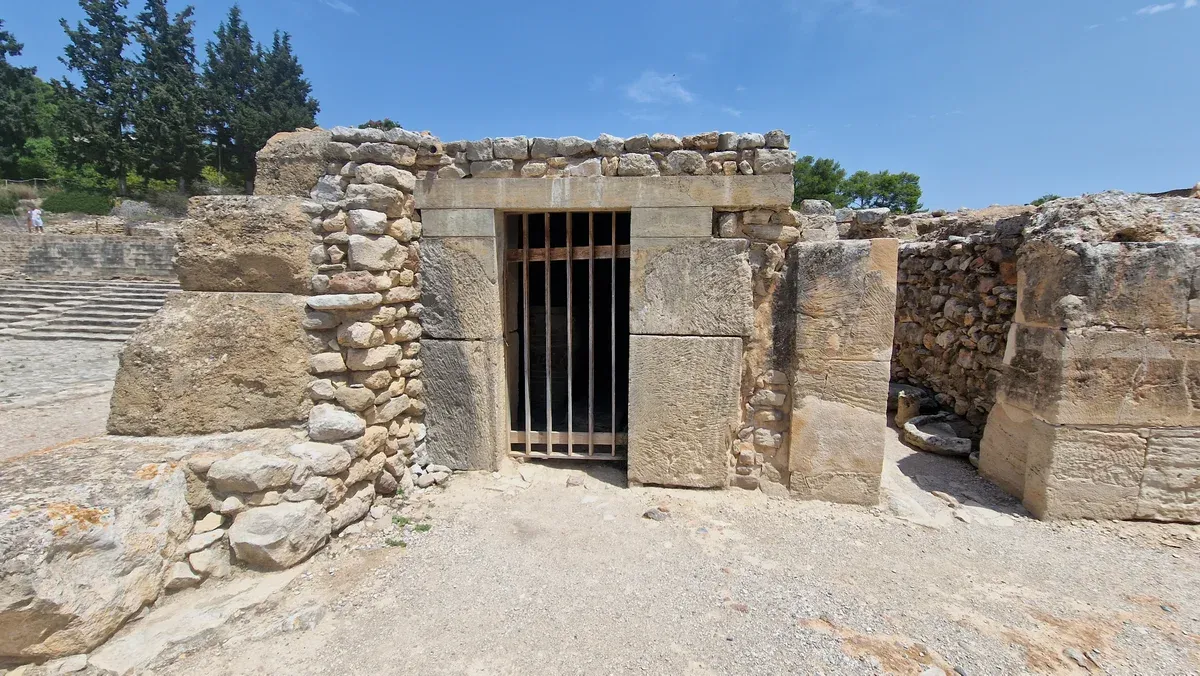
Photo: Rigorius, CC BY-SA 4.0, via Wikimedia Commons
What to See on Site
The ruins spread across several terraces, with a few points worth deliberately seeking out.
The Old and New Palaces
Built of ashlar blocks and spread across different terraces, the palaces open onto a central peristyle court, with the royal quarters, storerooms, a lustral basin and workshops arranged around it. A monumental propylon and large staircases, some of the best-preserved Minoan stonework on this side of the island, link the terraces to each other.
The Minoan and Later Town
Sections of the wider town have been located at two nearby sites, Chalara and Aghia Photeini, southeast and northeast of the palace respectively, evidence that Phaistos was a real city rather than a single palace building.
The Venetian Church of St George
West of the palace, on the road toward the Agia Triada site and Matala, stands the small Venetian-era church of St George of Phalandra, a reminder that the hill stayed in use long after the Minoans and Romans left it.
The Pottery in the Storerooms
The storerooms and magazines held more than the large pithoi jars now visible in situ. Wikipedia's account of the excavated finds lists bridge-spouted bowls, eggshell-thin cups and polychrome Kamares Ware vases, pottery with embossed decoration imitating metalwork, among the finds that explain why Phaistos ranks among the richest Minoan pottery sites on the island even without Knossos's frescoes.
Monument descriptions from the Ministry of Culture's Phaistos description page and Wikipedia.
Hours and Getting There
Phaistos sits far enough south that most visitors see it as part of a south-coast day rather than a stand-alone trip from Heraklion.
Special Holiday Hours
Unlike Knossos, which closes outright on several holidays, Phaistos runs shortened special hours of 08:00 to 17:00 on 6 January, 15 August and 28 October rather than closing entirely. It does close fully on 1 January, 25 March, 1 May, Easter Sunday and 25-26 December.
Pairing With Gortyn and Matala
Gortyn, the Roman-era capital that eventually conquered Phaistos, sits directly on the road back toward Heraklion, making a two-site day straightforward without backtracking. Matala, with its Roman rock-cut caves and beach, is a short continuation south of Phaistos on the same road, and is the second stop on the one tour that visits Phaistos directly.
By Bus
No KTEL bus runs directly to the Phaistos gate. The nearest public service is the Heraklion-Matala route via Moires, three times a day on weekdays and weekends alike per the KTEL Herakliou-Lasithiou timetable, which passes within a short taxi ride of the site rather than stopping at it. Most independent visitors drive or join a tour instead, since the bus leaves a final leg unaccounted for.
How Much Time to Give Phaistos
The Ministry does not publish a recommended length. Three routings cover how most south-coast days actually use the site.
A direct walk through the two palace courts and the propylon covers the core of the site. Adding the wider town remains and the view terraces takes longer. Most visitors fold Phaistos into a bigger Messara-plain day rather than treating it as a destination on its own.
| Routing | On Site | Adds | Skips |
|---|---|---|---|
| Quick stop | about 45 minutes | The old and new palace courts, the propylon and staircases | Chalara, Aghia Photeini, the Venetian church |
| Full visit | 1 to 1.5 hours | The quick stop plus the wider town remains and the view terraces over the Messara plain | Nothing on site |
| South-coast day | Half a day | Phaistos plus Gortyn and Matala on the one tour that runs this route | A separate trip for each site |
Phaistos in Dated Lines
A short chronology pieced from the Ministry's own pages and Wikipedia.
-
Neolithic period
First Habitation
The hill is inhabited from the Neolithic period, well before any palace is built.
-
15th century BC
Palace Built, Then Destroyed
The Minoan palace reaches its developed form, then is destroyed.
-
15th-8th century BC
Mycenaean and Geometric City
The city continues through the Mycenaean and Geometric periods.
-
Hellenistic period (3rd-2nd c. BC)
Renewed Prosperity
The city grows wealthy again, with houses from this period still visible on the upper west court terrace.
-
Mid-2nd century BC
Destroyed by Gortyn
Neighbouring Gortyn destroys and absorbs Phaistos, ending its independence.
-
1884
Excavation Begins
Italian archaeologist F. Halbherr starts investigating the site.
-
1900-1904
Italian School Excavations
Halbherr and L. Pernier excavate for the Italian Archaeological School at Athens.
-
3 July 1908
The Phaistos Disc Found
Luigi Pernier discovers the still-undeciphered disc during excavation.
-
1950-1971
Doro Levi's Excavations
A second major excavation campaign runs under Doro Levi.
-
2025
UNESCO World Heritage Listing
Phaistos is inscribed alongside Knossos as part of the "Minoan Palatial Centres" listing.
Sources: the Ministry of Culture's Phaistos history page, Wikipedia and the Phaistos Disc page.
Dos and Don'ts at Phaistos
A quieter site than Knossos, but the same sun and the same lack of shade.
Do
- Bring water and sun protection. The hilltop site has little shade and the Messara plain traps summer heat.
- Walk to the view terraces even if you skip the wider town remains. The outlook over the plain toward Mount Ida is the site's real payoff.
- Pair it with Gortyn on the drive back, since it sits directly on the same road.
- Drive or book a tour rather than relying on a bus. No KTEL route stops at the gate.
- Visit the Heraklion Archaeological Museum to actually see the Phaistos Disc, since it is not displayed on site.
Don't
- Don't expect to see the original Phaistos Disc at the palace. It has been in Heraklion since its discovery.
- Don't expect Knossos-style reconstruction. The ruins are unrestored, which asks more imagination but shows more of the real excavation.
- Don't plan a public-transport day without a backup. The nearest bus passes near, not at, the site.
- Don't skip Chalara and Aghia Photeini if time allows. They show Phaistos was a real town, not just a palace.
- Don't visit at midday in July or August without shade and water. The hilltop has no shelter from the sun.
Five Things Most Visitors Do Not Know
Quick, sourced facts for the drive back along the Messara plain.
- Phaistos covers about 8,400 square metres, roughly two-thirds the footprint of Knossos, and its theatral area is actually larger than the one at Knossos (Wikipedia).
- The palace's royal apartments were built from alabaster and deliberately positioned to face Mount Ida, Crete's highest peak (Wikipedia).
- Phaistos was destroyed not by an earthquake or an invasion but by its neighbour Gortyn, in the middle of the 2nd century BC (Ministry of Culture history page).
- Beyond the famous disc, the site has produced 61 other inscribed Linear A items, 26 tablets and 35 sealed documents among them (Wikipedia).
- Phaistos was inscribed as a UNESCO World Heritage Site only in 2025, alongside Knossos, as part of the joint "Minoan Palatial Centres" listing (Wikipedia).
Phaistos and Nearby on the Map
Phaistos sits on the Messara plain, with Gortyn on the road back toward Heraklion and Matala a short continuation south.
- 1 PhaistosThe second-largest Minoan palace on Crete, above the Messara plain. $16.84 (€15).
- 2 GortynThe Roman-era capital that destroyed and absorbed Phaistos in the 2nd century BC. $11.23 (€10).
- 3 MatalaRoman rock-cut caves above a sandy beach, a short drive south of Phaistos.
- 4 Heraklion Archaeological MuseumWhere the Phaistos Disc actually lives, about an hour north.
Numbers match the pins on the map.
Near Phaistos
Three stops that extend a Messara-plain day in either direction.
Gortyn
The Roman-era capital of Crete, and the city that eventually destroyed Phaistos. Its famous Law Code inscription is the main draw.
On the road back toward Heraklion Check info & availabilityMatala
Roman-era rock-cut tombs used as caves above a sheltered sand beach, the natural continuation of a Phaistos morning.
Short drive south Check info & availabilityHeraklion Archaeological Museum
Where the actual Phaistos Disc, and most of what was excavated here, is on permanent display.
About an hour north Check info & availabilityPhaistos Questions
What is the mystery of the Phaistos Disc?
The disc carries 45 distinct symbols stamped in a spiral, occurring 242 times across both sides, and no scholar has produced a decipherment with general acceptance. It is not even settled whether it represents a language, a game, a calendar or something else entirely.
What does Phaistos mean?
Phaistos is the Greek name for the Minoan and later city on this site, also spelled Festos. We found no single confirmed etymology for the name's original meaning.
Has the Phaistos Disc been solved?
No. Despite many attempted decipherments since its 1908 discovery, no solution has achieved scholarly consensus, and it remains one of archaeology's best-known unsolved puzzles.
Where is the Phaistos Disc now?
It is on permanent display at the Heraklion Archaeological Museum, not at the Phaistos site itself.
Is Phaistos worth visiting?
Yes, particularly if you are already touring the south coast for Matala or the Messara plain. It is quieter than Knossos, shows unrestored Minoan stonework, and the hilltop setting over the plain is worth the detour on its own.
How much does it cost to visit Phaistos?
$16.84 (€15) full price, $8.98 (€8) reduced, paid at the Ministry's own gate.
Is Phaistos a UNESCO World Heritage Site?
Yes, since 2025, inscribed alongside Knossos as part of a joint "Minoan Palatial Centres" listing rather than as a standalone site.
Can I get to Phaistos by bus?
Not directly. The nearest KTEL service is the Heraklion-Matala route via Moires, which passes near the site rather than stopping at the gate. Most visitors drive or book a tour instead.
Phaistos on Video
Phaistos: History of the Second Largest Minoan City
A history-focused walkthrough covering the palace's full timeline.
Video: Wanax TVPhaistos, the Jewel of Minoan Crete
A 4K look at the site's terraces and its Messara plain setting.
Video: The PeriegeteThe Minoan Tablet We Still Can't Solve
A deeper look at the Phaistos Disc and why it has resisted decipherment.
Video: Stefan MiloWe may earn a commission if you book through one of our links, at no extra cost to you. Full affiliate disclosure