 Crete Island Guide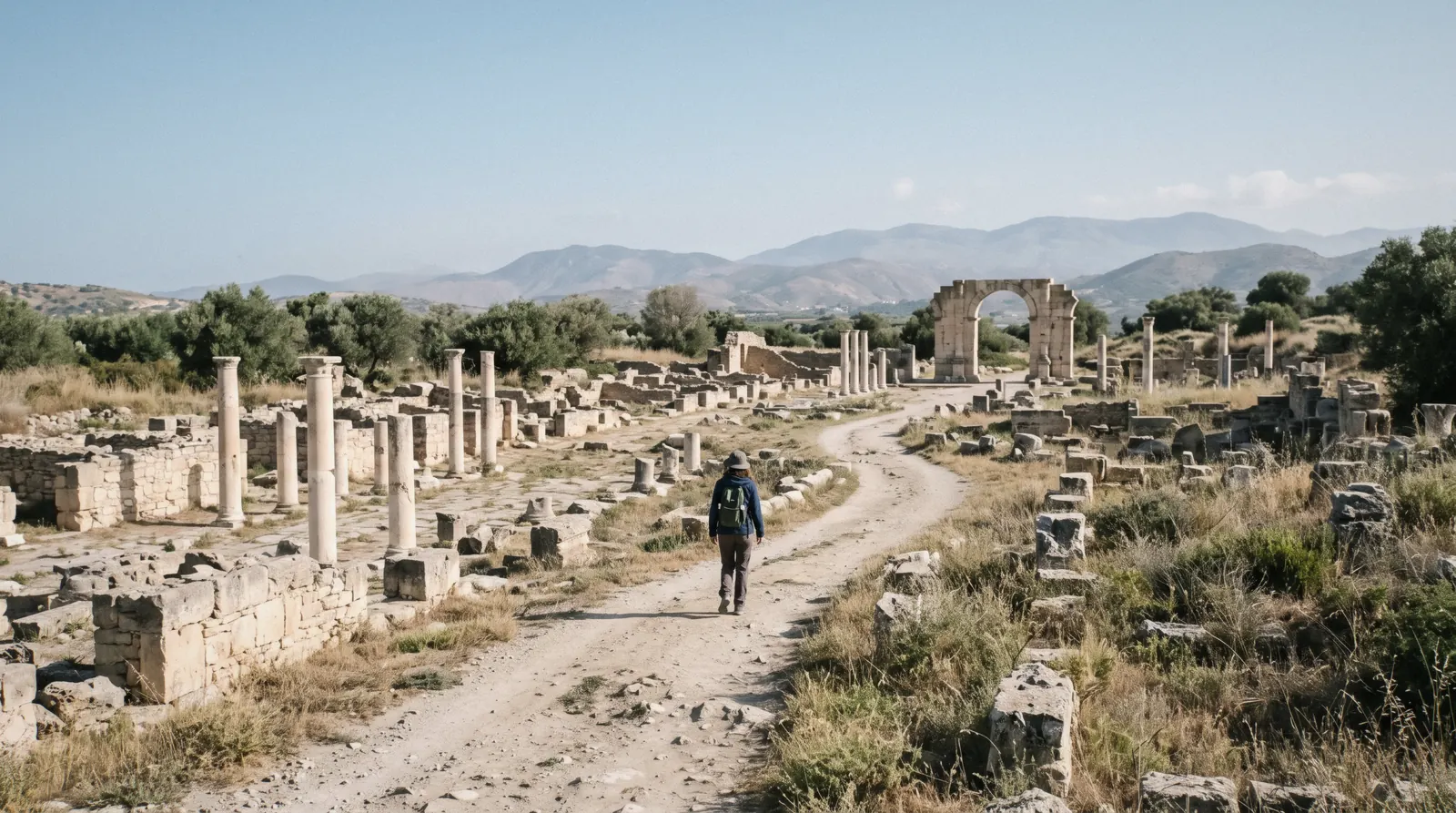
Gortyn ran all of Roman Crete, and part of North Africa with it, from this spread of ruins on the Messara plain south of the island our Crete Island Guide covers. This page covers the honest price and hours, since we sell no ticket here ourselves, the Gortyn Law Code still readable in its original stone, and why most visitors drive straight past it on the way to Phaistos.
Quick answer Gortyn in one minute
Gortyn was the capital of Roman Crete and, for a time, the joint Roman province of Crete and Cyrenaica in North Africa, and it still holds the Gortyn Law Code, the oldest known complete code of ancient Greek law, carved into stone blocks now sheltered inside the site's Odeion. Entry costs $11.23 (€10) full price, $5.61 (€5) reduced, paid at the gate since no tour on this page sells the entry itself. Summer hours run 08:00 to a close that steps down from 20:00 to 18:00 across September and October. Allow 1 to 1.5 hours, and expect one of the quietest major sites on the island.
Key takeaways
- No tour sells entry here. Pay $11.23 (€10) at the gate, or see Gortyn's road on the private day tour to Phaistos and Matala, which runs directly past it.
- The Law Code is the single thing worth planning around. Head straight for the Odeion to read it in its sheltered wall.
- Pair it with Phaistos, a short drive further along the same road, the city that eventually destroyed it the other way around in an earlier century.
- Expect ruins with little shade. Visit early or bring sun protection for the open Roman street grid.
Key facts
Opening hours
| 1 April–31 August | 08:00–20:00 |
|---|---|
| 1–15 September | 08:00–19:30 |
| 16–30 September | 08:00–19:00 |
| 1–15 October | 08:00–18:30 |
| 16–31 October | 08:00–18:00 |
| 1 November–31 March (winter) | 08:30–15:30 |
Closed Closed 1 January, 25 March, Easter Sunday, 1 May, 25-26 December. 6 January, Shrove Monday, 15 August and 28 October run shortened special hours (08:30-15:00) rather than a closure.
Admission
- Adult
- $11.23 (€10)
- Reduced
- $5.61 (€5), for the categories the Ministry lists
Planning it
- Time needed
- Not stated by the Ministry. Our routing: 1 to 1.5 hours.
- Book ahead
- Optional — walk-up usually fine
- Address
- Gortyn archaeological site, Messara plain, near the village of Agioi Deka
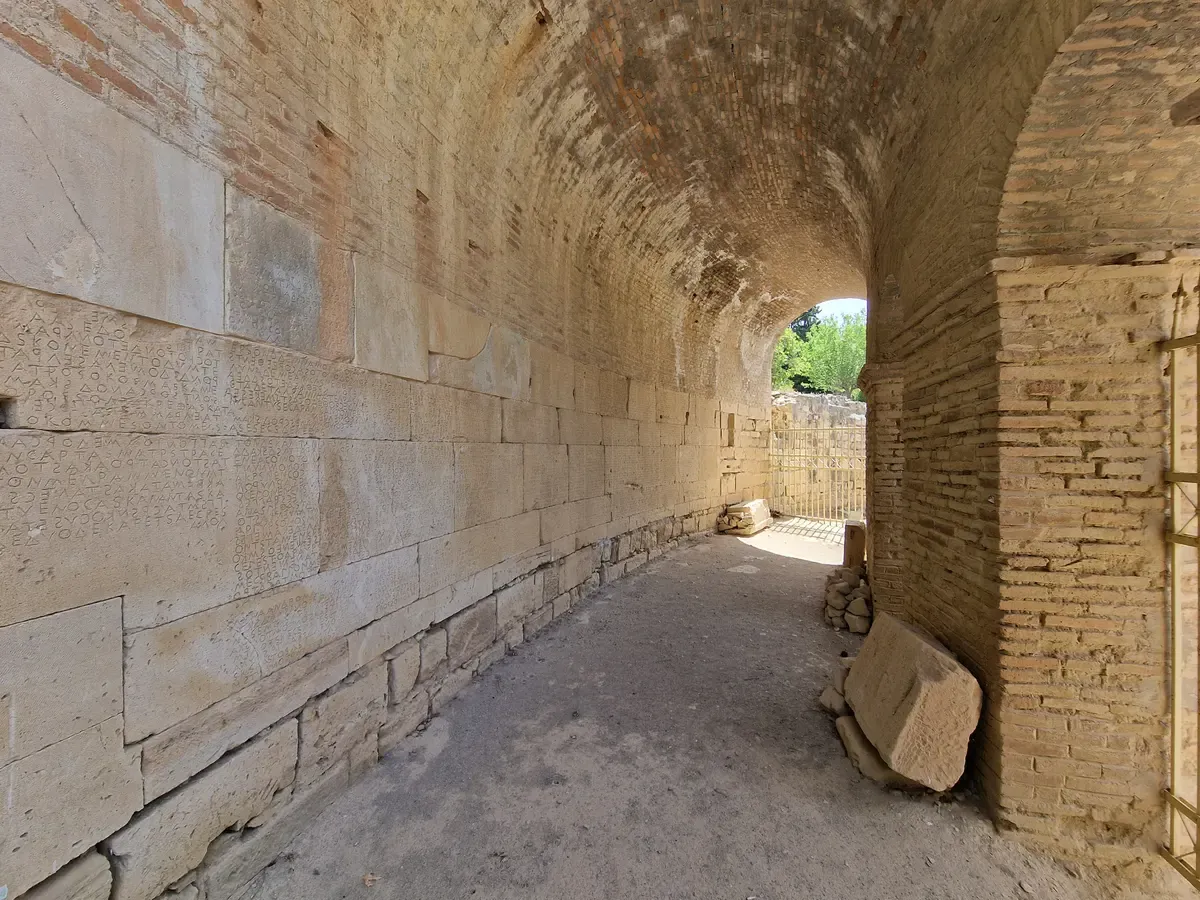
Photo: Rigorius, CC BY-SA 4.0, via Wikimedia Commons
Gortyn Price
We sell no ticket for Gortyn ourselves, so the Ministry's own gate price is the price and its own page is the link.
| Where to Buy | Price | Includes | Notes | Book |
|---|---|---|---|---|
| Ministry ticket office, at the gate | $11.23 (€10) full, $5.61 (€5) reduced | Entry to the Odeion, the Law Code and the wider ruin field | No advance booking needed; the site is rarely busy | Official site |
Figures are the Ministry of Culture's own published price. Figures current for Q4 2026.
See Gortyn on a Day Tour
No tour on this page lists a stop at Gortyn specifically. The private day tour below runs the same Messara-plain road to Phaistos and Matala, passing directly through Gortyn, by our estimate, without a scheduled stop.
 from $94.03
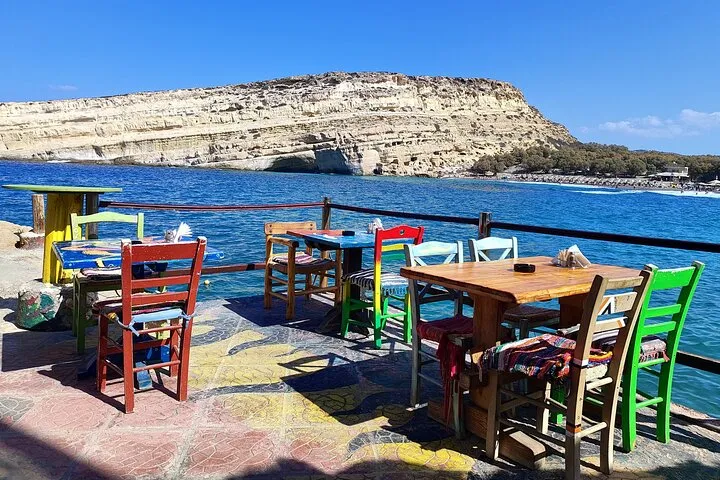
Matala Beach + Caves, Phaistos Palace & Southern Charm | Private
A private day to the Minoan palace of Phaistos and Matala beach with its caves, on the south side of the Messara plain.
Check AvailabilityPrices, ratings and details are the platform's own. dollar figures are the listed prices — the platform bills in your account's currency.
What Gortyn Is: Crete's Roman Capital
Gortyn's importance has nothing to do with the Minoans, which is unusual on an island whose tourist map is otherwise built around Bronze Age palaces.
A Late Bloomer
Gortyn was first inhabited at the end of the Neolithic period, around 3000 BC, and flourished much later, in the Late Minoan period (1600-1100 BC), when a villa with a shrine was founded at nearby Kannia. Archaic-era habitation, from the 7th century BC, is found in the area of its Acropolis, and by the Hellenistic period (3rd-2nd century BC) the city was prosperous enough to carve the inscription it is still known for.
A Civil War, Then a Roman Alliance
Before Rome ever arrived, Gortyn's own Cretans fought each other. The Lyttian War of 220 BC split the island's cities into rival camps, Gortyn among them, per Wikipedia's account. When Rome later moved against Crete, the Roman general Quintus Caecilius Metellus Creticus invaded in 68 BC and destroyed several resisting cities, but Gortyn, having allied itself with Rome, avoided that fate, a decision that set up everything that followed.
Capital of Crete and Cyrenaica
That alliance paid off. During the Roman period (1st-5th centuries AD) Gortyn reached the peak of its prosperity as the capital of the joint province of Crete and Cyrene, administering Roman Crete and part of what is now Libya from this one inland city. That scale, a Roman provincial capital rather than a regional town, is the context for the extensive ruin field visitors walk today.
History from the Ministry of Culture's Gortyn description page and Wikipedia.
History: Christianity, Martyrdom and Arab Destruction
Gortyn's Roman-era prosperity gave way to an early and violent Christian history, then a sudden end.
Saint Titus and the Ten Saints
The Apostle Titus is said to have preached Christianity at Gortyn, and the city became the seat of Crete's first bishop. Around AD 250, ten Christians, now venerated as the Ten Saints of Crete, were martyred here. A basilica dedicated to St Titus was built on the site in the 6th century AD, by which time Gortyn had become an archbishop's seat in its own right.
Destroyed by the Arabs
In AD 824, Gortyn was destroyed by invading Arab forces, who went on to establish their own state on Crete. The city never recovered its earlier status, and the ruins visible today are largely what survived or was later excavated from that destruction.
Excavated Since 1884
The first investigations at Gortyn were conducted in 1884 by the Italian archaeologist F. Halbherr, the discovery of the Law Code dating to that same year's work, and excavation has continued since under the Italian Archaeological School and the Greek Ephorate of Antiquities.
History from Wikipedia and the Ministry of Culture's Gortyn history page.
The Gortyn Law Code
The reason Gortyn appears in textbooks has nothing to do with its buildings and everything to do with twelve columns of carved text, rediscovered almost by accident.
Twelve Columns, Written Backwards and Forwards
The code is carved across 12 columns running about 10 metres long and 1.5 metres high, roughly 600 lines in total, written in the Dorian dialect of ancient Greek. The text uses boustrophedon style, alternating direction line by line the way an ox ploughs a field, rather than running left to right throughout. It dates to the first half of the 5th century BC, making it one of the oldest substantial legal texts to survive from the Greek world in anything like complete form.
What the Law Actually Covers
This is not a ceremonial inscription. The code sets out real, detailed rules on disputed ownership of slaves, rape and adultery, marriage and divorce, custody of children after a divorce, inheritance and the management of property, the sale and mortgaging of land, adoption, and the different rules that applied to marriages between slave, free and foreign-status people. Reading even a translated excerpt gives a far more concrete sense of daily Cretan life than the ruins around it do on their own.
Found Twice, By Accident
Italian archaeologist Federico Halbherr found four columns of the text in 1884 while excavating near a local mill, not expecting a legal code at all. Recognising what he had, he secured permission to dig further and uncovered eight more columns, whose stones, it turned out, had been pulled from their original location and reused as foundation material for a much later building. That building was the Odeion, built in the Roman period under Emperor Trajan, meaning the Law Code had already been an antique curiosity, worth quarrying for building stone, centuries before Halbherr ever arrived.
The Odeion today shelters the inscription on the same wall where Trajan's builders left it.
Dating, content and rediscovery details from Wikipedia and the Ministry of Culture's Gortyn description page.
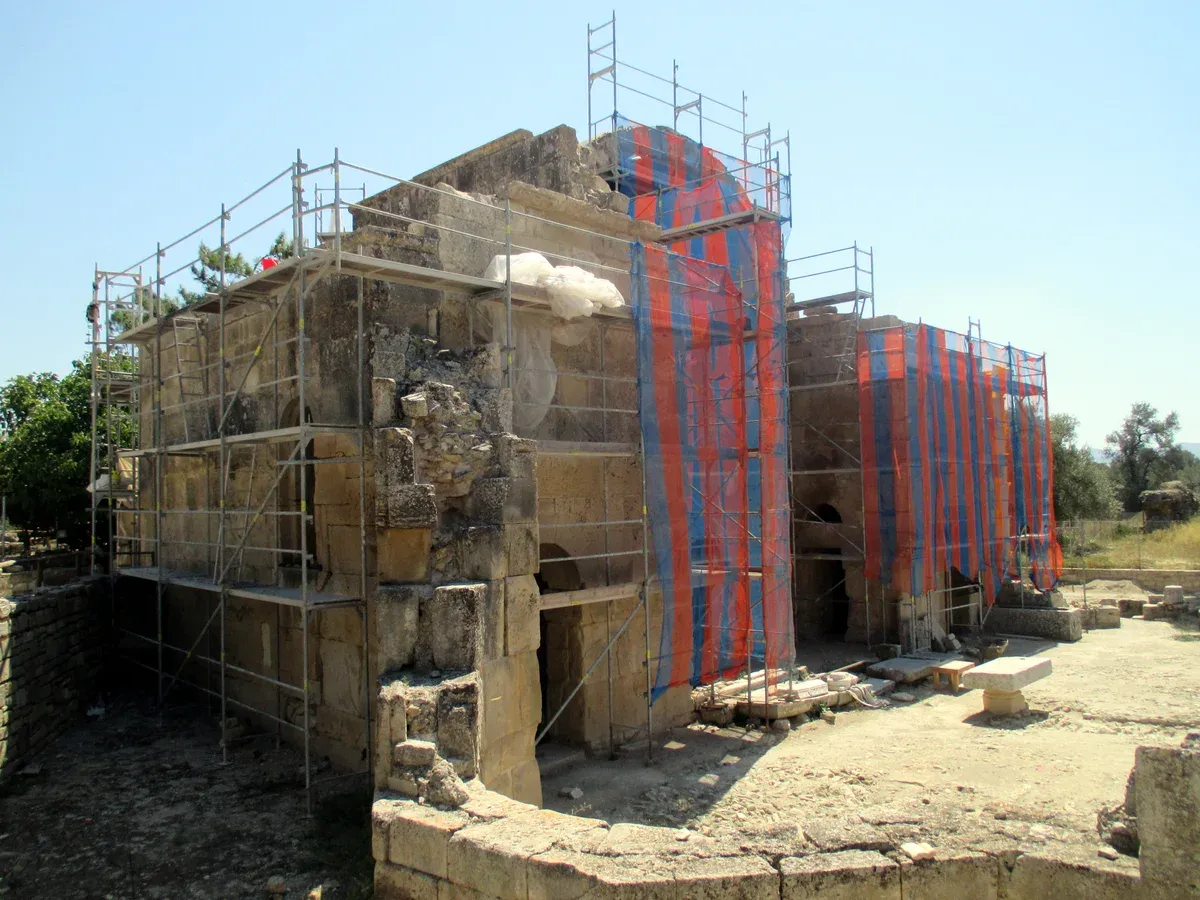
Photo: Tomisti, CC BY-SA 4.0, via Wikimedia Commons
What to See: The Odeion, the Basilica and the Pythion
Gortyn's ruins spread wide, so a short visit benefits from picking three stops rather than attempting the full field.
The Odeion and the Law Code
The Roman-era Odeion, a small theatre for music and poetry readings, was built directly around the older Law Code inscription, now sheltered in its north wall. It is the first stop for most visitors and the most photographed single feature on site.
The Basilica of St Titus
The 6th-century basilica dedicated to St Titus, Crete's first bishop, stands as one of the best-preserved Early Christian buildings on the island, its presbytery arches still largely intact.
The Temple of Apollo (Pythion)
The Pythion, a temple to Apollo, sits among the wider Roman ruin field and is one of the clearest surviving religious structures from the city's pre-Christian Roman centuries, a reminder that Gortyn's history runs through several different religious eras on the same ground.
The Praetorium: Seat of the Roman Governor
The Praetorium was the seat of the Roman governor of Crete, built in the 1st century AD and altered repeatedly over the following eight centuries, per Wikipedia's account. It is the clearest physical marker of Gortyn's administrative role, the building a visiting Roman official would actually have worked from.
Baths, an Arch and a Temple to Egyptian Gods
The wider Roman ruin field also includes public baths (thermae), an honorary arch, and a temple to Egyptian deities holding worship statues of Isis, Serapis and Anubis, evidence of how far Roman Crete's trade and religious contacts reached. A separate 2nd-century AD theatre, with two entrances and a half-circular orchestra, stands apart from the Odeion, so the two performance buildings should not be confused with each other.
Monument identification from the Ministry of Culture's Gortyn description page and Wikipedia.
Getting There and Pairing With Phaistos
Gortyn sits directly on the main road south from Heraklion toward Phaistos and Matala, which is both its convenience and the reason it gets overlooked.
By Car
Most traffic heading to Phaistos or Matala drives straight through Gortyn without stopping, since it sits on the same road rather than requiring a detour. Building in 30 to 45 minutes here on the way, our estimate rather than an official figure, turns a Phaistos day into a two-palace, one-law-code outing without adding meaningful driving time. We have no official source for parking at Gortyn, so treat it as a local, on-the-day detail.
By Bus
No KTEL route stops at Gortyn by name. The Heraklion-Matala service via Moires, three times a day on the KTEL Herakliou-Lasithiou timetable, runs the same road and passes close to the site, but confirm the nearest drop-off locally rather than assuming a direct stop. Most independent visitors drive or join a tour instead.
How Much Time to Give Gortyn
The Ministry does not publish a recommended length. Three routings cover how most Messara-plain days actually use the site.
A direct walk to the Odeion and the Law Code covers the one thing nobody should skip. Adding the Basilica and Praetorium takes longer. Seeing the full Roman ruin field, baths, arch, temples and separate theatre included, is a longer stop than most south-coast day trips budget for.
| Routing | On Site | Covers | Skips |
|---|---|---|---|
| Quick stop | 30 to 45 minutes | The Odeion and the Law Code | The Basilica, Praetorium and wider ruin field |
| Full visit | 1 to 1.5 hours | The quick stop plus the Basilica of St Titus and the Praetorium | The baths, arch and Egyptian temple |
| Messara plain day | Half a day | Gortyn plus Phaistos and Matala on the one tour that runs this route | A separate trip for each site |
Gortyn in Dated Lines
A chronology pieced from the Ministry's own pages and Wikipedia.
-
c. 3000 BC
First Habitation
The site is first inhabited at the end of the Neolithic period.
-
1600-1100 BC
A Late Minoan Villa
A villa with a shrine is founded at nearby Kannia, the city's first flourishing.
-
7th century BC
Archaic Settlement
Habitation is found in the area of the Acropolis.
-
5th century BC
The Law Code Carved
The Gortyn Law Code is inscribed, the oldest substantial Greek legal text to survive intact.
-
220 BC
The Lyttian War
Rival Cretan cities, Gortyn among them, fight a civil war that splits the island.
-
68 BC
Rome Invades, Gortyn Survives
Quintus Caecilius Metellus Creticus invades Crete; Gortyn, allied with Rome, avoids the destruction other cities suffer.
-
1st-5th centuries AD
Roman Provincial Capital
Gortyn governs Roman Crete and Cyrenaica from the Praetorium, reaching its peak prosperity.
-
2nd century AD
The Odeion Built
Emperor Trajan's builders construct the Odeion, reusing the centuries-old Law Code stones as part of its wall.
-
c. AD 250
The Ten Saints Martyred
Ten Christians are martyred at Gortyn, later venerated as the Ten Saints of Crete.
-
6th century AD
Basilica of St Titus
A basilica dedicated to Crete's first bishop is built, by which time Gortyn is an archbishop's seat.
-
AD 824
Destroyed by the Arabs
Invading Arab forces destroy Gortyn, ending its status as Crete's leading city.
-
1884
The Law Code Rediscovered
Federico Halbherr finds the first four columns near a local mill, then eight more reused in the Odeion's foundations.
Sources: Wikipedia and the Ministry of Culture's Gortyn history page.
Dos and Don'ts at Gortyn
A spread-out site with almost no shade, so the plan matters more than the ruins' individual labels.
Do
- Head straight for the Odeion first. The Law Code is the one thing worth building the stop around.
- Read a translated excerpt of the Law Code before or after visiting. The inscription itself is unreadable to a non-specialist without one.
- Pair it with Phaistos on the same drive, since it sits directly on that road.
- Bring water and sun protection. The ruin field is open and largely unshaded.
- Budget 30 to 45 minutes minimum even on a tight schedule, our estimate, since the Odeion alone rewards a proper look.
Don't
- Don't confuse the Odeion with the separate 2nd-century theatre elsewhere on site. They are two different buildings.
- Don't expect a posted bus stop. No KTEL route names Gortyn as a stop, only a nearby passing service.
- Don't skip the Praetorium if you have the full visit's time. It is the clearest marker of Gortyn's status as a provincial capital, not just a ruin field.
- Don't drive past without stopping at all. Most traffic does, and the Law Code justifies more than a glance from the car.
- Don't expect dramatic standing structures everywhere. Much of the site is foundation-level ruins rather than intact buildings.
Five Things Most Visitors Do Not Know
Quick, sourced facts for the drive on to Phaistos.
- The Gortyn Law Code's stones were already centuries old, and already being reused as building material, when the Romans built the Odeion around them in the 2nd century AD under Emperor Trajan (Wikipedia).
- Federico Halbherr found the code almost by accident in 1884, starting with four columns near a local mill before securing permission to uncover eight more (Wikipedia).
- The code is written in boustrophedon style, alternating direction line by line the way an ox ploughs a field, rather than reading left to right throughout (Wikipedia).
- Gortyn avoided the destruction Rome inflicted on other Cretan cities in 68 BC specifically because it had allied itself with Rome beforehand (Wikipedia).
- A separate temple on site held worship statues of the Egyptian gods Isis, Serapis and Anubis, evidence of how far Roman Gortyn's religious contacts reached beyond Crete (Wikipedia).
Gortyn and Nearby on the Map
Gortyn sits on the Messara-plain road between Heraklion and Phaistos, making it an easy add-on rather than a separate trip.
- 1 GortynThe Roman-era capital of Crete and Cyrenaica, and home of the Gortyn Law Code. $11.23 (€10).
- 2 PhaistosThe Minoan palace Gortyn eventually destroyed and absorbed, a short drive further along the same road. $16.84 (€15).
- 3 MatalaRoman-era rock-cut caves above a sand beach, the natural continuation of a Messara-plain day.
- 4 HeraklionCrete's capital, the usual start point for a Gortyn and Phaistos day.
Numbers match the pins on the map.
Near Gortyn
Three stops along the same Messara-plain road.
Phaistos
The second-largest Minoan palace on Crete, and the city Gortyn eventually conquered. Most visitors see both the same day.
Short drive further south Check info & availabilityMatala
Roman-era rock-cut tombs used as caves, above a sheltered beach at the end of the Messara-plain road.
Continuation of the same road Check info & availabilityHeraklion
Crete's capital, the usual starting point for a Gortyn and Phaistos day trip.
About 45 minutes north, our estimate Check info & availabilityGortyn Questions
What is the Gortyn Code?
The Gortyn Law Code is the oldest known complete code of ancient Greek law, carved into stone blocks around the 5th century BC and still sheltered inside the site's Odeion, built around it in the Roman era.
Why is Gortyn important?
Gortyn was the capital of Roman Crete and, for part of its history, of the joint Roman province of Crete and Cyrenaica in North Africa. It also preserves the Gortyn Law Code, a foundational document for the study of ancient Greek law, in its original stone.
Is Gortyn worth visiting?
Yes, especially as an add-on to a Phaistos or Matala day, since it sits directly on the same road. The Odeion and Law Code alone justify a 30 to 45 minute stop, our estimate, without a separate trip.
How much does it cost to visit Gortyn?
$11.23 (€10) full price, $5.61 (€5) reduced, paid at the Ministry's own gate.
What are Gortyn's opening hours?
Summer hours run from 08:00, closing between 18:00 and 20:00 depending on the fortnight. Winter hours from 1 November are 08:30 to 15:30. Several holidays run shortened hours rather than a full closure.
Gortyn on Video
Gortyn: Metropolis of Roman Crete
A history-focused overview of Gortyn's role as Roman Crete's capital.
Video: Scenic Routes to the PastGortyna: The Roman Capital of Crete and Libya, Drone Aerial
Aerial footage showing the full scale of the ruin field.
Video: Polychronis FilmAncient City Gortyna, Crete Greece
A ground-level walk through the Odeion, basilica and wider site.
Video: Traveller ABCWe may earn a commission if you book through one of our links, at no extra cost to you. Full affiliate disclosure